NPO2
1L - increased FiO2 by 4%
Simple face mask
6-10L ~ 35-60%
VM 30-60%
HFM 02 ~ 10-15L/min
rebreathing 70-80%
non-rebreathing 95-100%
Showing posts with label Emergency Medicine. Show all posts
Showing posts with label Emergency Medicine. Show all posts
Friday, 6 September 2013


Sunday, 18 August 2013
AEBA
Drugs
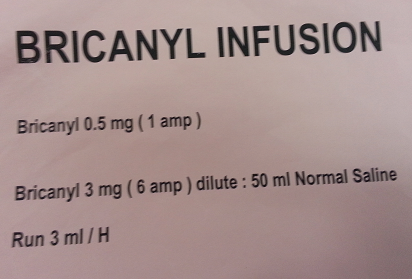
Bricanyl (terbutaline) - selective beta 2 agonist
SC bricanyl 0.5mg (1 ampule)
Infusion: 3.0mg (6 ampules) in 50cc NS - run 3ml / H
Salbutamols sulfate - 1 ampule = 1ml = 500mg
subcutaneous
8mcg/kg 4 hourly
adult 250mg = 0.5ml
Infusion
5-20mcg/min
3mg (6ampule) in 50cc D5%
1ml/h = 1mcg/min
MgSO4
2.47g (1ampule) in 5ml
2.0g slow bolus (4ml MgSO4 dilute in 46cc NS - run 50cc over 10-20min)
Wednesday, 24 July 2013
Rapid Sequence of Intubation (RSI)
Definition
administration of potent induction agent
after pre-oxygenation
followed immediately by rapidly acting neuromuscular blocking agent
to induce unconscious and motor paralysis for tracheal intubation
without interposed positive airway ventilation
7 P's
1. Preparation
2. Pre-oxygenation
3. Pre-treatment
4. Paralysis with induction
5. Positioning
6. Placement with proof
7. Post-intubation management
A. Preparation
Prepare yourself, staffs, equipments
MALES + 4 S
Mask
Airways
Laryngoscope
ETT
4 S's
4 S's
Suction
Stylet
Stethescope
Syringe
Monitoring - cardiac, BP, pulse oxymetry
IV line - at least 1, preferably 2
Pharmacological agent - labeled
Laryngoscope
Suction
ETT - cuff tested for leak
Stylet
Ambu bag
LMA
Stethescope
Achoring tape
Ryle's tube
B. Pre-oxygenation
Principle
establishment of oxygen reservoir within the lung, blood and body tissue
to permit several minutes of apnoea
without arterial oxygen desaturation
Principle reservoir - functional residual capacity (FRC) ~ 30ml/kg
Method
Administration of 100% oxygen for 3 minutes
replaces predominantly nitrogenous mixture of room air with oxygen
allowing several minutes apnea time before Hb saturation <90%
C. Pre-treatment
administration of drugs to mitigate adverse effects associated with the intubation or patient's underlying comorbidities.
Adverse effects include
1. Bronchospastic reactive airway
2. Increased ICP
3. Reflex sympathetic response to laryngoscopy (RSRL)
Pre-treatment Drugs
Fentanyl 1mcg/kg over 30-60 sec
Lignocaine 1.0-1.5ml/kg
D. Paralysis with Induction
Administration of rapidly acting induction agent in a dose adequate to produce prompt LOC
immediately followed by neuromuscular blocking agent
Induction agents
1. Midazolam 0.1-0.5mg/kg
2. Ketamine 2.0mg/kg
3. Etomidate 0.3mg/kg
4. Propofol 2.0-2.5mg/kg
Ketamine
Adv : good bronchodilator, use in severe hypotension/shock
Disad : Increased BP/HR/ICP/muscle tone/salivation/intraoccular pressure, readily cross placenta
Etomidate
Adv : Very cardiostable - used in cardiac patient and haemodynamically unstable ptx
Disad : Suppresion of synthesis of cortisol with infusion
Propofol
Adv : Conscious sedation
Disadv : Depression of cardiovascular / repiratory system, allergic reaction
Neuromuscular blocking agents
1. Scolene (suxamethonium / succinylcholine) - depolarising muscle relaxant
Adult 1mg/kg
Children 2mg/kg
Neonate 3mg/kg
Onset : within 60sec
Duration : 3-5minutes
Adverse effects
- hyperkalaemia (increased by 0.5mmol/l)
- Bradycardia
- malignant hyperthermia
- increased ICP/IOP
2. Esmeron (recuronium) - non-depolarising muscle relaxant
Dose 0.6-1.2mg/kg
SE: hypokalaemia
Test for patient's jaw for flaccidity
~45sec after administration of scolene
~60sec after administration of rocuronium
If scolene is used, fasciculation will be observed
E. Positioning
Sellick maneuvre (application of firm pressure on cricoid cartillage to prevent passive regurgitation)
F. Placement with proof
Direct visualisation
Calorimetric end tidal CO2 detector
Vapour in ETT
SPO2 monitoring
6 points auscultation
Chest rise
G. Post-intubation management
ETT anchoring
RT insertion - confirmed by rapid introduction of air in 10cc syringe with auscultation at epigastic
Hypotension -common, often caused by
1. Diminised venous return as a result of increased intra-thoracic pressure
2. Haemodynamic effects of induction agent
Self limited, respond to fluid resuscitation
administration of potent induction agent
after pre-oxygenation
followed immediately by rapidly acting neuromuscular blocking agent
to induce unconscious and motor paralysis for tracheal intubation
without interposed positive airway ventilation
7 P's
1. Preparation
2. Pre-oxygenation
3. Pre-treatment
4. Paralysis with induction
5. Positioning
6. Placement with proof
7. Post-intubation management
A. Preparation
Prepare yourself, staffs, equipments
MALES + 4 S
Mask
Airways
Laryngoscope
ETT
4 S's
4 S's
Suction
Stylet
Stethescope
Syringe
MARBLES x 2 is an alternative for the
equipment and planning:
· Masks (NP, NRB, BVM) and monitoring
· Airway adjuncts (e.g. OPA, NPA, LMA) and
Ask for difficult airway trolley
· RSI drugs and Resus drugs
· BVM and Bougie
· Laryngoscopes
· ETT and ETCO2
· Suction and State Plan
Monitoring - cardiac, BP, pulse oxymetry
IV line - at least 1, preferably 2
Pharmacological agent - labeled
Laryngoscope
Suction
ETT - cuff tested for leak
Stylet
Ambu bag
LMA
Stethescope
Achoring tape
Ryle's tube
B. Pre-oxygenation
Principle
establishment of oxygen reservoir within the lung, blood and body tissue
to permit several minutes of apnoea
without arterial oxygen desaturation
Principle reservoir - functional residual capacity (FRC) ~ 30ml/kg
Method
Administration of 100% oxygen for 3 minutes
replaces predominantly nitrogenous mixture of room air with oxygen
allowing several minutes apnea time before Hb saturation <90%
C. Pre-treatment
administration of drugs to mitigate adverse effects associated with the intubation or patient's underlying comorbidities.
Adverse effects include
1. Bronchospastic reactive airway
2. Increased ICP
3. Reflex sympathetic response to laryngoscopy (RSRL)
Pre-treatment Drugs
Fentanyl 1mcg/kg over 30-60 sec
Lignocaine 1.0-1.5ml/kg
D. Paralysis with Induction
Administration of rapidly acting induction agent in a dose adequate to produce prompt LOC
immediately followed by neuromuscular blocking agent
Induction agents
1. Midazolam 0.1-0.5mg/kg
2. Ketamine 2.0mg/kg
3. Etomidate 0.3mg/kg
4. Propofol 2.0-2.5mg/kg
Ketamine
Adv : good bronchodilator, use in severe hypotension/shock
Disad : Increased BP/HR/ICP/muscle tone/salivation/intraoccular pressure, readily cross placenta
Etomidate
Adv : Very cardiostable - used in cardiac patient and haemodynamically unstable ptx
Disad : Suppresion of synthesis of cortisol with infusion
Propofol
Adv : Conscious sedation
Disadv : Depression of cardiovascular / repiratory system, allergic reaction
Neuromuscular blocking agents
1. Scolene (suxamethonium / succinylcholine) - depolarising muscle relaxant
Adult 1mg/kg
Children 2mg/kg
Neonate 3mg/kg
Onset : within 60sec
Duration : 3-5minutes
Adverse effects
- hyperkalaemia (increased by 0.5mmol/l)
- Bradycardia
- malignant hyperthermia
- increased ICP/IOP
2. Esmeron (recuronium) - non-depolarising muscle relaxant
Dose 0.6-1.2mg/kg
SE: hypokalaemia
Test for patient's jaw for flaccidity
~45sec after administration of scolene
~60sec after administration of rocuronium
If scolene is used, fasciculation will be observed
E. Positioning
Sellick maneuvre (application of firm pressure on cricoid cartillage to prevent passive regurgitation)
F. Placement with proof
Direct visualisation
Calorimetric end tidal CO2 detector
Vapour in ETT
SPO2 monitoring
6 points auscultation
Chest rise
G. Post-intubation management
ETT anchoring
RT insertion - confirmed by rapid introduction of air in 10cc syringe with auscultation at epigastic
Hypotension -common, often caused by
1. Diminised venous return as a result of increased intra-thoracic pressure
2. Haemodynamic effects of induction agent
Self limited, respond to fluid resuscitation
Thursday, 27 June 2013
PALS - Pulseless Arrest

ETT size
<1kg 2.0
1-2kg 2.5
2-3kg 3.0
Size (mm) = 4 +age/4
Anchor (cm) = 12 + age/2
Estimated weight
Age <9yr = (2xage) +9
Age >9yr = 3xAge


Organophosphate Poisoning
SLUDGE
Salivation
Lacrimation
Urination
Defaecation
Gastric emptying
Emesis
'Drowning in the own secretion'
a. bronchorrhoea
b. bronchospasm
c. pulmonary oedema
Altered mental state
Muscle weakness
Odour of garlic


Wednesday, 26 June 2013


Hyperglycaemia
Serum effective osmolality
= ( 2xNa + glucose ) >320mmol/L
Serum total osmolality
= ( 2xNa + glucose + urea) >330mmol/L
Anion gap
= [Na] + [K] - [HCO3] - [Cl]
Normal value : 3-11 (high anion gap in DKA)


Subscribe to:
Posts (Atom)