
Suggested WHO Classification 2009

A continuum of pathophysiological changes from normal circulation to compensated and decompensated/ hypotensive shock

Adapted from:
Ganong WF. Cardiovascular homeostasis in health and disease. In: Review of
Medical Physiology. 22nd Edition. London: McGraw-Hill; 2005:p.630-46.
Clinical and Laboratory Criteria for Patients Who Can be Treated at Home
- Able to tolerate orally well, good urine output and no history of bleeding
- Absence of clinical alarm signals (refer Table 5)
- Physical examination:
- Haemodynamically stable
- pink, warm extremities
- normal capillary filling time (normal <2 seconds)
- good pulse volume
- stable blood pressure
- normal pulse pressure (> 20mmHg)
- no disproportionate tachycardia
- No tachypnoea or acidotic breathing
- No hepatomegaly or abdominal tenderness
- No bleeding manifestation
- No sign of pleural effusion ascites
- No alterations in mental state and full GCS score
- Investigation:
- Stable serial HCT
- In the absence of a baseline HCT level, a HCT value of >40% in female adults and >46% in male adults should raise
CRITERIA FOR HOSPITAL REFERRAL / ADMISSION
- Symptoms :
- • Alarm signals
- • Bleeding manifestations
- • Inability to tolerate oral fluids
- • Reduced urine output
- • Seizure
- Signs :
- • Dehydration
- • Shock (refer to Table 1)
- • Bleeding
- • Any organ failure
- Special Situations :
- Patients with co-morbidity e.g.Diabetes, Hypertension, Ischaemic Heart Disease, Coagulopathies,
- Morbid Obesity, Renal Failure,Chronic Liver disease, COPD,
- Elderly (more than 65 years old)
- Pregnancy
- Social factors that limit follow-up e.g. living far from health facility, no transport, patient living alone, etc
- Laboratory Criteria: Rising HCT accompanied by reducing platelet count
ALGORITHM FLUID MANAGEMENT IN COMPENSATED SHOCK

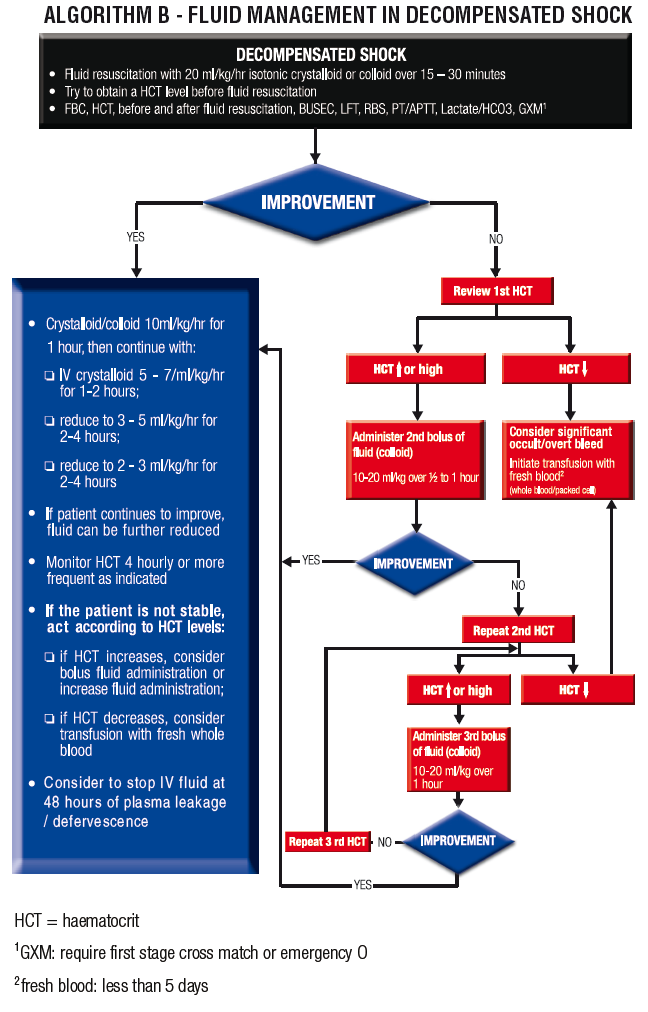
ALGORITHM FLUID MANAGEMENT IN DECOMPENSATED SHOCK
DISCHARGE CRITERIA
• Afebrile for 48 hours• Improved general condition
• Improved appetite
• Stable haematocrit
• Rising platelet count
• No dyspnoea or respiratory distress from pleural effusion or ascites
• Resolved bleeding episodes
• Resolution/recovery of organ dysfunction

